

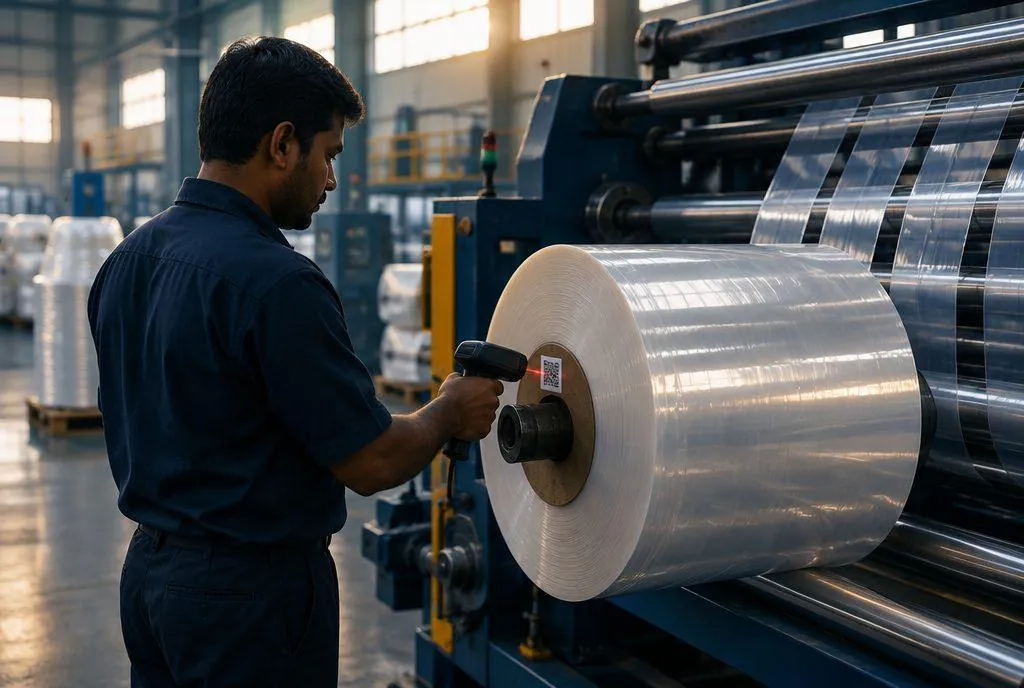
A cast polyethylene film plant does not make one product in one step. Resin and masterbatch are blended, cast into film, perforated, printed, slit to customer widths and packed. Edge trim and rejected film go back through a reprocessing machine and return as raw material. Rolls wait between stages, get held for quality, and sometimes go to one customer printed and to another plain.
We wrote the business requirements for a manufacturer like this: a cast polyethylene film maker with two units. This article is about the modelling decisions in that design, and why we made them. It is not a go-live story. There are no results here, because the measure of a design is what happens on the shop floor, and that comes later.
Our stance, in one line: each stage as its own work order, a batch per roll, kg as the unit. Do not let the BOM pretend it is one step.
Seven stages, not one
The tempting model is a single bill of materials: resin, masterbatch and ink in, finished roll out. It is short to configure and it demos well. It also hides almost everything the plant needs to manage.
A single-step BOM cannot tell you how much film came off the casting line before perforation. It cannot hold a roll after printing while quality looks at it. It cannot show yield at slitting separately from yield at casting. And when a customer wants the same film unprinted, it has nothing to branch from.
So the design models the chain stage by stage:
- Blending
- Casting
- Perforation
- Printing
- Slitting
- Packing
- Reprocessing, where edge trim and rejected film become reusable raw material for blending
Each forward stage has its own intermediate item and its own work order, producing a roll or pack that the next stage consumes. Work orders come from sales orders through ERPNext's standard Production Plan, so the plant can run make-to-order and make-to-stock side by side. Where a product skips a stage, for example plain film that is never printed, its BOM simply does not include that step.
This is more configuration than a single BOM, and more work orders for supervisors to close. It is also the only model in which stage yield, stage scrap and work in progress are real numbers rather than guesses.
Kg as the stock unit
Film is bought, made and costed by weight, but customers often order by roll or by length. The design keeps kilograms as the stock unit throughout, and adds conversion factors for the units customers buy in.
The conversion between kilograms and metres is not one number for the plant. It depends on width, thickness and the density of the material, so it belongs to each finished item, not to the unit itself. That is a strong argument for the next decision.
Item variants for GSM, width, type and print
A film plant's catalogue is a grid. The same film is sold in different weights per square metre, different widths, different types and with or without a print. ERPNext's item variants fit this: one template item with attributes for GSM, width, type and print, and a variant for each combination the plant actually makes.
The warning is in "actually makes". Variants multiply quickly. Four attributes with a handful of values each can produce hundreds of combinations, most of which nobody will ever order. Our rule is to create variants only for combinations that are sold, and to add new ones when an order needs them. A catalogue that lists every theoretical combination is a catalogue nobody can search.
A batch per roll
Every roll is a batch. That one decision gives the plant traceability without a custom traceability system.
When a roll is produced at a stage, it gets a batch number and a QR label printed from the system. When it is issued to the next stage, the operator scans it at a terminal. The work order that consumes it records exactly which batches went in. Follow those links backwards from a finished roll and you reach the cast roll it came from, and from there the raw material batches that were blended.
The terminals matter as much as the data model. Operators enter data at their machine, see only their own stage, and scan rather than type. A traceability design that depends on someone copying roll numbers from paper at the end of the shift is a paper system with extra steps.
Scrap as raw material, not as loss
Edge trim and rejected film are not waste in this plant. They go through a reprocessing machine and come back as input to blending. The design models that loop explicitly: scrap is recorded at the stage that produces it, reprocessed in its own work order, and returned to stock as a reusable raw material.
That closes the material balance. Without the loop, scrap disappears from the books at one stage and reappears as unexplained raw material at another, and nobody can say what a stage really yielded.
Quality at the gate, on the line and at dispatch
Quality in a film plant is usually a register somebody keeps. The design puts it inside the transactions:
- Versioned inspection templates, approved by the quality head, so a change to a test or a tolerance is a new version with a date, not an edit nobody notices.
- A QC gate on receipt, with lab and machine sections, before raw material can be used.
- In-process checks during production.
- An outgoing inspection on the delivery note.
- A certificate of analysis printed per roll.
The purchase side has its own gate. A gate entry document is mandatory on every goods receipt, and the weighbridge's gross, tare and net weights are recorded with a tolerance warning, so a short delivery is caught at the gate rather than at the mixer.
Two units, one company
The plant has two units. The question every multi-unit manufacturer asks is whether each unit should be its own company in ERPNext. The design answer was one company with a unit accounting dimension: separate profit and loss per unit, one set of masters, and no inter-company transactions for material that moves between units. Separate companies would have made sense only if the units were separate legal entities with separate GSTINs.
Phasing and costing
Not everything belongs in the first release. Standard costing comes first, so the plant can value stock and production from day one. Workstation hourly costing and OEE, which need reliable machine time and downtime data, are phase two. They depend on shop-floor entry being trusted first, and the only way to earn that trust is to run it.
The same principle applies to the order of modules. For a single plant with purchase, manufacturing, stock, accounts and sales, we would usually go live with purchase and stock first, manufacturing second, and sales and quality last.
Standard, configuration or custom
The requirements document classifies each requirement as standard ERPNext, configuration, or customisation. Most of what this article describes uses what ships with ERPNext: multi-level BOMs, work orders, production plans, item variants, batches, unit conversions, quality inspection templates and accounting dimensions. Knowing which requirement is which, and saying so line by line before anyone quotes is the most useful thing a requirements document does. We wrote more about it in Standard, configuration or custom.
What we do not know yet
A design is a set of bets. The ones we are most interested in watching: whether operators keep scanning at every stage when a line is running hard, whether the variant list stays disciplined, and whether stage yields from the system match what supervisors believe them to be. We will write about those once there is something true to say.
If this is your situation
If your rolls are tracked on paper between stages, or your BOM has one line where your plant has six, look at our manufacturing page and how we run an ERPNext implementation. Then send us your process, stage by stage, and we will tell you which parts are standard.